How AI and LLMs will impact go-to-market teams
On the continued impact of AI and LLMs on the B2B go-to-market function. What does the future hold?

Outbound Strategies: Human-Out-of-the-Loop?
Cold Email Personalization
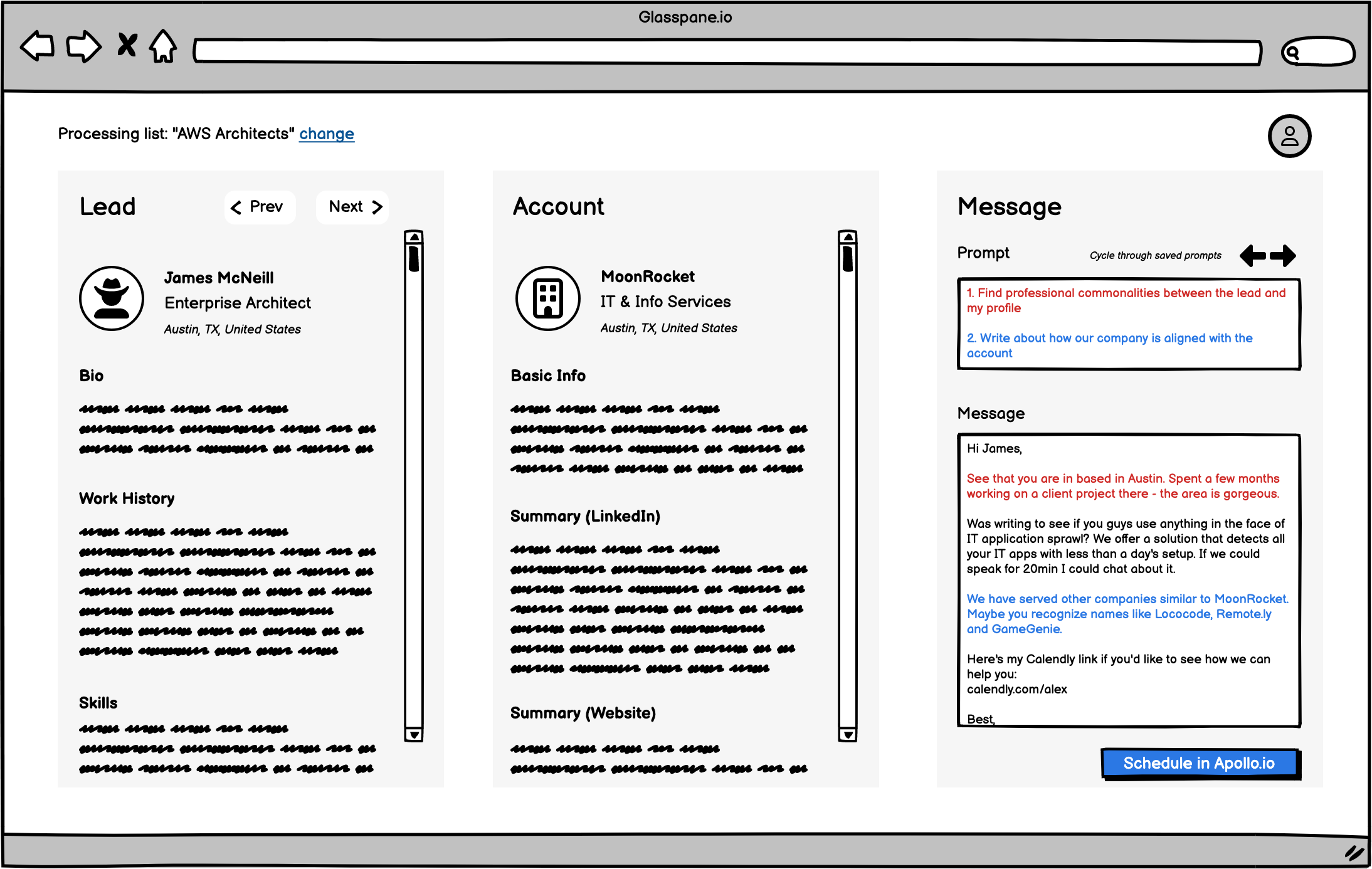
Slice for a personalization tool we envisioned. The ideal tool will draw deep insights from the account, lead, salesperson and selling company and dramatically cut time spent in the process.
In the coming years, we’ll likely witness a veritable gold rush of startups looking to leverage AI and large language models (LLMs) to enable personalization at scale. This wave of innovation could revolutionize how businesses approach outbound strategies like cold emailing.
Personalizing emails is still one of the most time-consuming tasks in the outbound sales process for many GTM teams, and being an activity with almost exclusively text-based inputs (ex: the lead and account profiles) and outputs (the personalization snippet), it’s prime for the application of LLMs.
Prospecting tools like Apollo have already begun to add AI personalization capabilities, and although the feature is very crude in my experience, the speed and decisiveness in its launch show that players in the space are very serious about it. Likewise, hot startups are emerging in the space like Persana AI, Coldreach (both from the same YC batch!), or Lavender.ai.
However, this begs the question: what happens once everyone leverages AI for personalization? Will the concept of “personalization” hold the same meaning when an AI carries out the task at a grand scale? These are questions that both startups and established firms will need to consider as they navigate this new landscape.
Cold-Calling
Recent advances in speech synthesis are pushing boundaries, making it plausible that even traditional methods like cold calling will experience transformation. In fact, Google showcased a glimpse of this future with its duplex demonstration a few years ago.
Although it’s hard to imagine voice agents being able to follow a real sales call, it’s not far-fetched to anticipate a surge in AI-enabled robocallers. These advanced systems could potentially conduct some preliminary qualification in the initial minutes of a call, transitioning to a human agent only after that.
While this is technologically feasible, cold-calling and voice communication in general will likely be less impacted by AI in the shorter term and may therefore serve as a temporary haven in a world increasingly flooded by AI-driven and impersonal text communication. Will we go back to cold-calling like it’s the 1980s?
Inbound Marketing: LLMs Steal the Show
Content Generation and SEO
When LLMs were first conceived, content generation was identified as a primary application. As François Chollet - an engineer at Google, creator of the Keras framework, and author of one of the seminal books in Deep Learning - puts it in his bear case for LLMs:
This brings up some intriguing questions: Will AI-generated content ever be genuinely interesting, or will it mirror the keyword-stuffed, SEO-driven content that has dominated the internet for the last decade? Moreover, will there be opportunities and incentives for producing high-quality content in such a landscape? Will good content move to more siloed properties (communities, newsletters, etc.) leaving the open internet to be a barren wasteland of filler?
(As a side note and full disclaimer, I have used GPT extensively to help with the authoring of this article. I will share more thoughts about this process in the near future, but for now, suffice it to say that it’s been a heavily involved human-machine collaboration and that I stand by its content and style)
LLMs as Leadgen and Awareness Tools
As the quote attributed to Charlie Munger goes: “Show me the incentive, and I will show you the outcome”. The potential rewards of adding promotional elements to LLMs is too large to ignore, and many players will attempt it one way or another.
We will in all likelihood see explicit and transparent advertising associated with LLM (eg ads on the side, like AdWords, reactive to user intent), and in some cases, perhaps embedded promotional content, influenced at the source. We cannot say yet if it’s statistically possible to influence LLMs responses, but we’re pretty sure some players will try, perhaps with a new breed of shady astroturfing techniques (abetted by LLMs!)
Another promotional opportunity for companies (and a less dystopian one) will lie in the development of plugins for popular LLM engines, such as the ecosystem that OpenAI is already building around ChatGPT.
GTM Analytics and Data: It’s All Natural, Baby
Emergence of Natural Language Tooling in Analytics
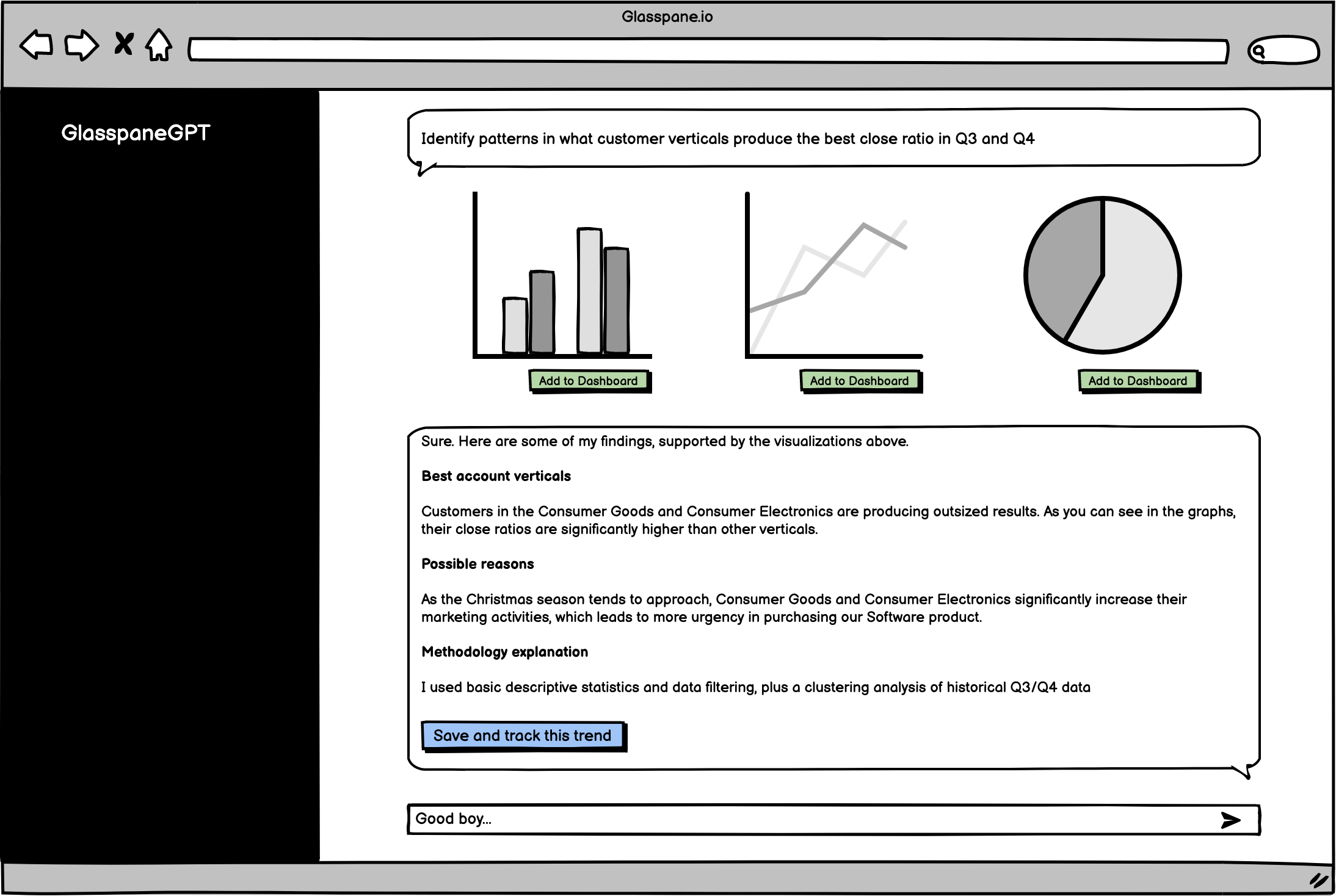
OpenAI has already demonstrated multimodal (multimedia) interaction and analysis with its code interpreter, and we expect a tight coupling of these capabilities with the CRM and the rest of the GTM stack
A significant trend in the domain of B2B marketing and sales analytics is the shift towards tools that lean heavily on natural language. As LLMs continue to develop and improve, the way we express and answer questions within analytical tools and dashboards will evolve. Instead of relying solely on coded commands or on rigid pre-built interfaces, queries will be formed using intuitive, everyday language, making advanced data analysis more accessible to non-technical users.
Combining LLMs with more traditional AI techniques
Traditional areas of AI applications in sales and marketing, such as predictive analytics and pattern finding (segmentation, clustering, etc.), will not only continue to improve with new architectures, but they might also blend with LLMs. This integration could facilitate chaining together models, resulting in enhanced data processing and decision-making capabilities. Furthermore, LLMs could be employed to express the results of these advanced models to human users in a comprehensible manner.
Data Engineering in Sales and Marketing
Data engineering, an already hot discipline globally, is poised to be of extreme importance in the B2B sales and marketing world. Data is the cornerstone of AI, and new swathes of data (such as transcriptions for sales calls) are already being collected in the context of sales and marketing.
Ensuring data quality is of paramount importance, and yet, many go-to-market teams still grapple with data quality issues. This necessitates the emergence of innovative solutions that leverage AI and LLMs to tackle these challenges and improve data quality, facilitating more accurate and efficient AI-driven processes. We hope to see improvements in the data capture process at the source, but perhaps also AI-driven tools that will help clean past data after the fact.
Transformative Effects on CRM Tools
This new era of data and analytics will also bring transformative changes to Customer Relationship Management (CRM) tools. Current incumbents may need to evolve to incorporate AI and LLMs, while we may also witness the emergence of a new wave of players built on entirely different design principles. These AI- and LLM-first CRMs could redefine the CRM landscape, leading to more intelligent, personalized, and efficient sales and marketing processes. Recent tools like Attio or Folk are only the tip of the iceberg, with the continued development of AI and LLMs likely to further inspire disruptors and visionaries.
While the full potential of these technologies is yet to be realized, it’s clear that the impact of AI and LLMs on analytics and data in sales and marketing will be substantial, with the power to reshape the B2B sales and marketing world fundamentally. We will sure be writing more and in much more detail about this topic, so watch this space.
Sales Enablement and Operations: New Interfaces
The rise of AI coaches will continue, with intelligent agents assisting salespeople when they need to close deals, thanks to natural language interfaces.
Sales operations are also set to become more complex with the growing intersection of humans, AI agents, and data processes. Intelligent automation will continue to streamline sales operations, possibly leading to a new wave of IPaaS tools that integrate LLMs, allowing for the design and maintenance of sales automated processes.
An interesting possibility will be the blend of Business Process Mining tools like Celonis, Business Process Model notation tools such as Camunda, integration tools like Zapier or Make, and LLM chat interfaces like ChatGPT in products that allow describing, designing, and streamlining sales and marketing processes.
Conclusions
While a few of these developments may seem ominous, painting a picture of a world where an honest sale becomes more challenging in the age of AI and salesperson and marketers are replaced by robots, there’s reason for optimism.
Sales and marketing functions will remain essential to commercial enterprises and it is certain that hyper-automation will shake things up. However, our bet is that the bulk of B2B trade will still hinge on human relations, insusceptible to AI until an event such as singularity occurs. Despite the impending changes and potential turmoil, there will be numerous opportunities for savvy salespeople, marketers, and technologists to gain the upper hand.
Ultimately, we envision a world with less mundane work and, perhaps paradoxically, more meaningful, humanized commercial relationships, as they become even more valuable in the era of AI.